

When it comes to catalytic converters, accuracy means everything. That is why RAS Cats uses Inductively Coupled Plasma (ICP) technology in our in-house lab during the assay process. ICP is the industry’s most precise method for measuring platinum, palladium, and rhodium. It uses atomic-level science to detect metals down to the parts per million. This accuracy ensures every supplier is paid for the true value of their material.
Over the next 6 blogs in our “Cat Assaying 101”, we will cover everything you need to hold your processor accountable and make sure you are getting the most for your catalytic converters.
How We Prepare Your Material for Testing in the Assay Process
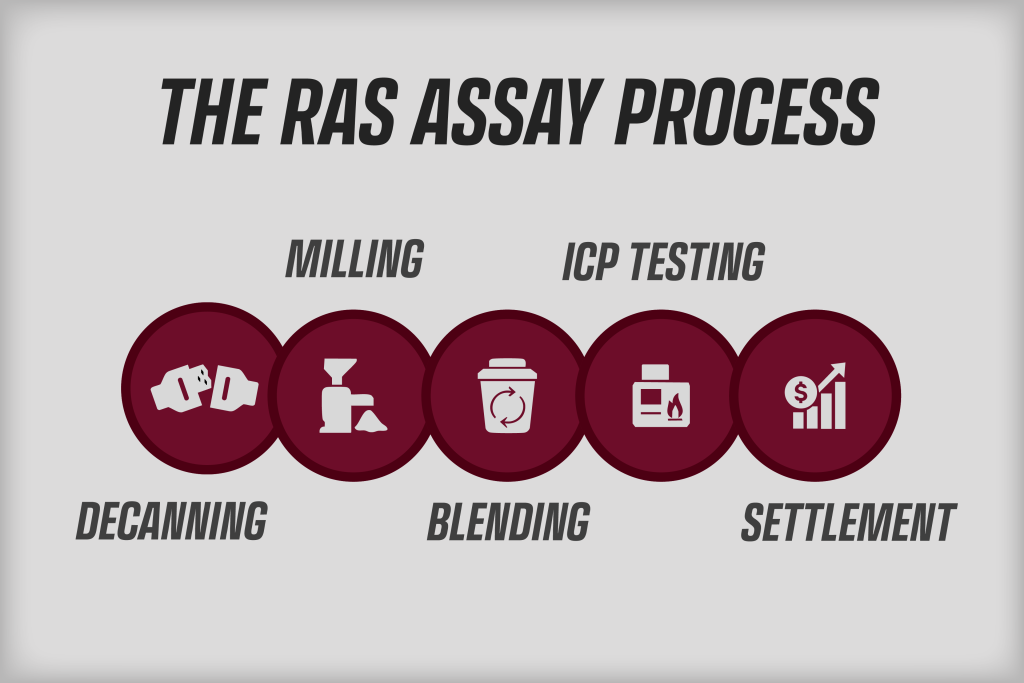
Great results start with great preparation. Before we run ICP analysis, every shipment goes through a controlled process to make sure testing is fair and consistent.
- Decanning – The ceramic core is removed from the steel shell.
- Drying – The ceramic core is dried to remove moisture.
- Milling – The ceramic is ground into a fine powder.
- Blending (Homogenizing) – The powder is blended into a uniform sample, so each lab subject represents the full shipment.
By the time your material reaches our lab, it is ready for testing that reflects the entire load, not just one portion.
Why Other Testing Methods Fall Short
Across the industry, many processors still use XRF (X-ray fluorescence) devices to evaluate converter material. These machines come in two forms:
- Handheld XRF – Small, portable, and lower cost.
- Tabletop XRF – Larger, more powerful, but still limited.
Both types provide quick readings, but neither has the precision required for settlement. XRF results often contain noise, which can create false readings. In some cases, XRF may even show platinum that is not actually present. While useful for quick checks, XRF cannot match the accuracy of ICP when real dollars are at stake.
Why RAS Relies on ICP in the Assay Process
RAS operates a full-service ICP lab in-house. Our equipment and our staff handle the complete process. By running ICP analysis, we eliminate noise, contaminants, and errors to deliver exact measurements of platinum, palladium, and rhodium.
This technology and expertise allow us to provide accurate results, faster payments, and full transparency. Suppliers can have complete confidence that their settlement reflects the real value of their converters.

What ICP Accuracy Means for You
When your converters are evaluated with ICP, your settlement is based on:
- The net dry weight of your material after processing – including baghouse dust.
- The verified parts per million content of platinum, palladium, and rhodium
- The prices for each metal
Together, these factors ensure that your payment is tied directly to reality, not to an estimate or an average.
What Comes Next in This Series
ICP accuracy connects directly to the Cat Value Triangle, which is built on Quantity × Quality × Price. This triangle is the foundation of every settlement, and we will explore it in detail in the next article in this series.
At RAS Cats, we believe suppliers should always know what is really happening to their material. With in-house ICP, we deliver unmatched accuracy and precision, so you are always paid for what your converters are truly worth.


